Genetic architecture of ecological specialisation in Arctic charr
The Arctic charr population in Þingvallavatn has a long and productive research history, serving as a key system for understanding ecological diversification and adaptive differentiation. This population exhibits striking morphological variation associated with benthic and limnetic specialisations, as well as pronounced differences in body size. Despite extensive research using a range of genetic and genomic approaches, a detailed understanding of the genetic architecture underlying these traits has remained a major challenge, particularly with respect to how multiple genomic regions contribute to complex phenotypes.
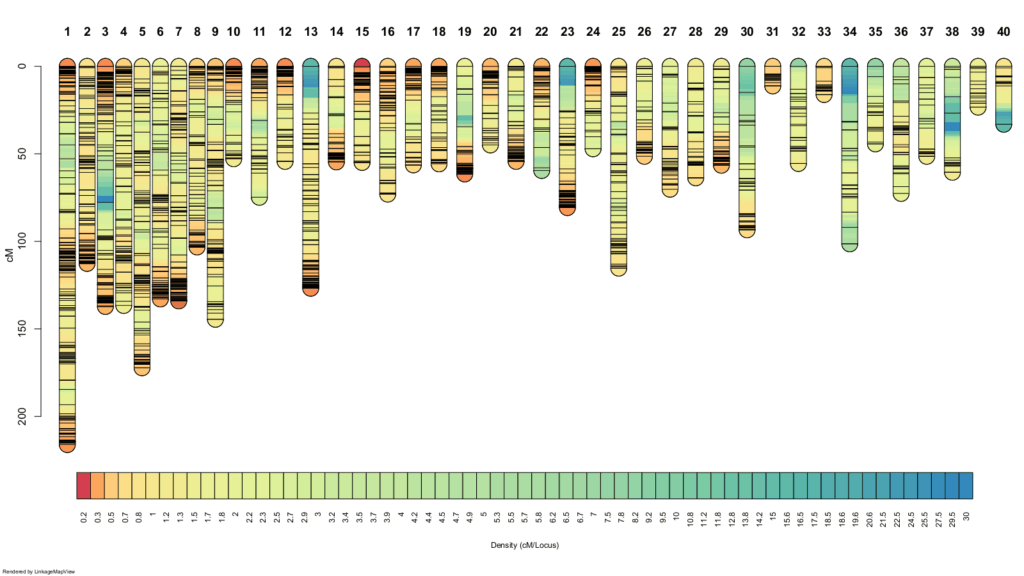
To address this, we used quantitative trait locus (QTL) mapping. Individuals from distinct morphs captured in Þingvallavatn were crossed and reared in captivity, resulting in five families and over 450 individuals. This allowed us to follow trait variation across multiple generations under controlled environmental conditions. This experimental design provided the foundation for constructing the first intergenerational linkage map for Arctic charr, enabling robust mapping of morphological traits related to ecological specialisation. This framework provides an important link between ecological theory and genomic data, and offers a valuable resource for future studies of adaptation and diversification in Arctic charr and other salmonids.
Female linkage map of Arctic charr. Warm colours represent areas of high marker density while cold colours represent areas of low marker density. Dark blue represents areas with a marker separation of 30cM or above. Rendered with LinkageMapView.