
Jónsdóttir, G.Ó., Ingimarsson, F., Snorrason, S.S. et al. Variation of Tooth Traits in Ecologically Specialized and Sympatric Morphs. Evol Biol 53, 67–84 (2026). https://doi.org/10.1007/s11692-026-09665-2
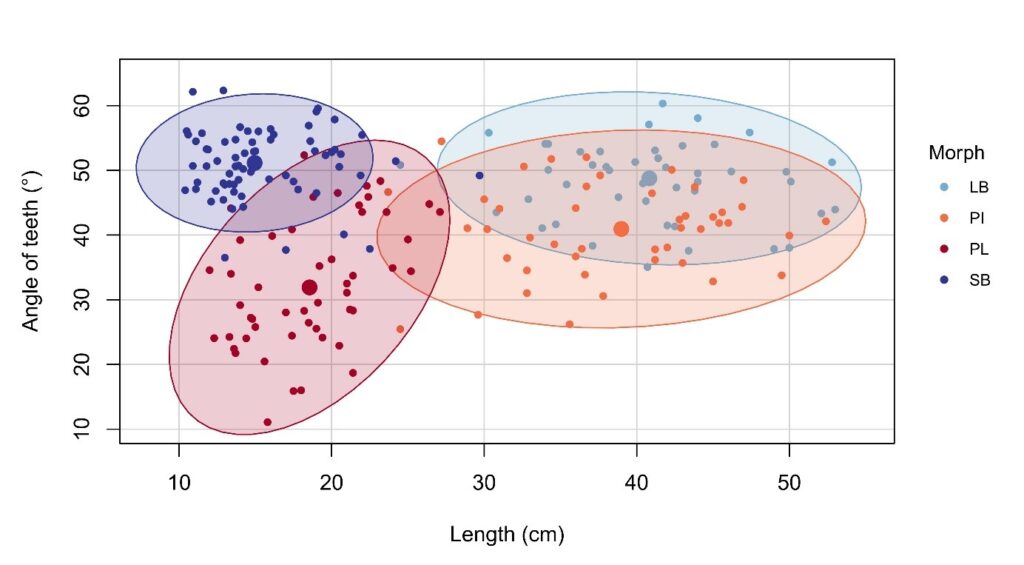
Differences in dentition between species relate to feeding specialisations, as examples of tetrapod dentition variation show clearly. The association of tooth traits and ecological opportunities in non-mammalian vertebrates is less studied. We examined variation in dental traits in four sympatric morphs of Arctic charr (Salvelinus alpinus) which differ in feeding specialisations, head and jaw bone morphology. We studied tooth numbers in six bones (dentary, maxilla, premaxilla, palatine, vomer and glossohyal) and tooth angles in one bone (maxilla). We found fluctuating asymmetry in tooth numbers and angles and that the allometry of tooth numbers varied by bone but not morphs. The premaxilla tooth numbers showed the least asymmetry, no difference between morphs and no allometry. Tooth numbers differed by morphs in four bones (dentary, palatine, vomer and glossohyal), with the morphs defined as pelagic having more teeth. There was also a difference in maxilla tooth angle, with benthic morphs having teeth which were angled more inwards. Previously we showed variation in bone shape and here we saw correlation between tooth number and bone shape. We hypothesize that tooth number differences are non-adaptive and are likely a correlated response to possible adaptive bone shape change. Maxilla tooth angle did not correlate with bone shape, we hypothesize tooth angle difference could be adaptive, not tested. While it is currently unknown what tooth characteristics are ancestral vs. derived in these populations, the marked differences in specific bones presents an opportunity to explore rapid evolution in dentition.